
Project Information
Arresting Conveyor Trough Deformation for High-Temperature Operation
Sanvira Carbon
Oman
Background of the Challenge
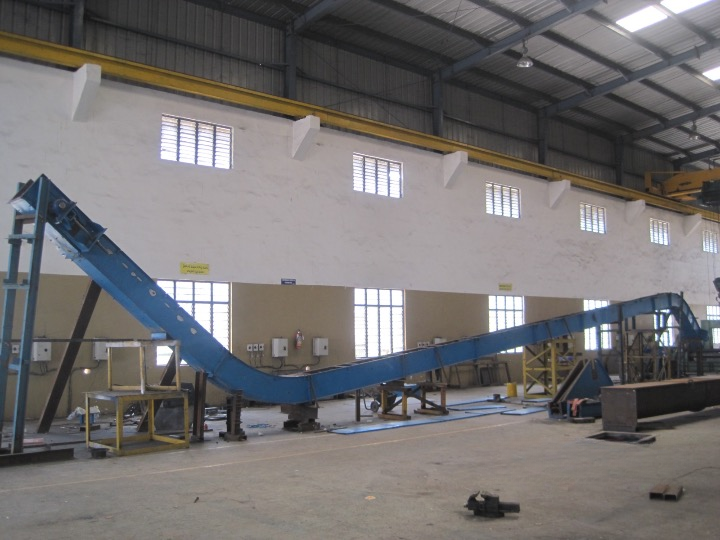
The client’s petcoke calcination system relied on a water-jacketed drag chain conveyor to transport hot calcined petcoke. This high-temperature and high-pressure environment placed extreme thermal stress on the conveyor system—particularly the trough sections—despite water-cooling measures.
The conveyor’s inner and outer troughs were warping due to the combined temperature and pressure stress. This deformation caused the chain and scraper plates to repeatedly jam, leading to:
1. Frequent unplanned downtime
2. Reduced process efficiency
3. Safety and material handling concerns
Our Solution
Turbovent addressed the issue through a data-driven, engineering-based redesign process.
1. Thermal & Pressure Stress Analysis
Using Computational Fluid Dynamics (CFD), we identified critical stress zones within the trough, helping us pinpoint exactly where the deformation was occurring.
2. Trough Redesign with Reinforcement
Based on the CFD results, we redesigned the conveyor bottom trough to include additional structural reinforcements, effectively resisting high thermal and pressure loads.
Results & Gains for the Client
1. Improved Operational Reliability
The conveyor now operates smoothly, with no chain or scraper plate jamming.
2. Better Heat Management & Product Quality
The reinforced design facilitated improved heat dissipation, ensuring consistent output quality—crucial for downstream processes.
3. Increased System Efficiency
The solution resulted in higher uptime and improved overall performance of the calcination system.
Key Learnings
1. Water cooling alone isn’t sufficient in high-temperature environments—both thermal and mechanical stress must be addressed to prevent conveyor trough warping.
2. CFD analysis is essential for diagnosing stress points and guiding effective engineering interventions.
3. Targeted reinforcement based on data prevents failure and extends equipment life.
4. Redesign driven by modeling, not assumptions, delivers better results in high-stress industrial systems.